By Honeyzzz | Health & Wellness | 7 min read
Not all honey is created equal.
Walk into any store and you will find jars labelled “honey” sitting side by side — some priced at ₹150, others at ₹800. They look similar. They are both amber-coloured and sweet. But what is inside those jars could not be more different.
The real divide in the honey world is not about brand or price. It is about one fundamental question: has this honey been processed, or has it been left the way nature made it?
What Is Raw Honey?
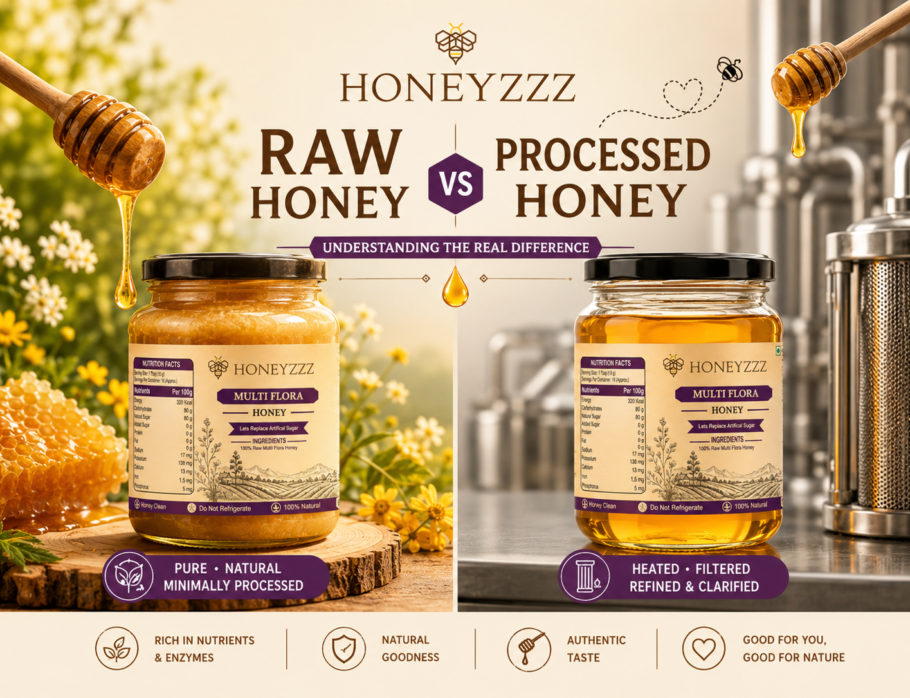
Raw honey is honey in its most natural form. It goes from the hive to the jar with minimal interference — filtered gently to remove large debris like wax and bee parts, but never heated, never blended with syrups, and never stripped of its natural composition.
What you get is exactly what the bees made: a dense, complex, living substance packed with natural enzymes, antioxidants, bee pollen, propolis, vitamins, and minerals. Every batch carries the distinct character of the flowers the bees foraged from, the season it was harvested, and the land it came from.
Raw honey is the version that has been trusted for thousands of years — in Ayurvedic medicine, in home remedies, and in kitchens across India long before processed food existed.
What Is Processed Honey?
Processed honey — also called commercial or refined honey — is what fills most supermarket shelves.
To produce it at scale and make it shelf-stable for longer, manufacturers heat the honey to high temperatures, typically between 70°C and 80°C. This makes it easier to filter at speed and prevents crystallisation, which makes the product look cleaner and more uniform in stores.
The result is a product that is visually appealing, consistently liquid, and long-lasting. But in exchange, the heat destroys most of what made the honey valuable in the first place.
What Actually Gets Lost in Processing
Here is where the difference becomes significant — not just in taste, but in what the honey does for your body.
Enzymes. Raw honey contains naturally occurring enzymes like diastase and glucose oxidase, which support digestion and have gentle antimicrobial properties. High heat deactivates these completely.
Antioxidants and polyphenols. These compounds are responsible for honey’s anti-inflammatory and immune-supporting properties. Studies have consistently shown that heating honey significantly reduces its antioxidant content.
Bee pollen. One of the most nutritious components of raw honey, bee pollen contains amino acids, vitamins, and trace minerals. Ultra-filtering removes it entirely — which also makes it nearly impossible to verify the honey’s origin or floral source.
Propolis. A powerful natural antibacterial compound produced by bees to protect the hive, propolis is present in trace amounts in raw honey. Processing removes it.
Natural structure. Raw honey has a complex biological makeup that is not fully understood even today. What is understood is that heat fundamentally alters it — and not for the better.
A Side-by-Side Look
| Raw Honey | Processed Honey | |
| Natural enzymes | Intact | Destroyed |
| Antioxidants | High | Significantly reduced |
| Bee pollen | Present | Removed |
| Texture | Thick, dense | Thin, uniform |
| Crystallisation | Yes — natural | Resists artificially |
| Shelf appearance | May vary by season | Consistently clear |
| Flavour | Complex, floral | Flat, uniformly sweet |
| Processing | Minimal | High heat + ultra-filtering |
Does Processing Make Honey Unsafe?
No — processed honey is not harmful. But it is significantly less beneficial.
When you choose processed honey, you are largely getting a natural sweetener with a pleasant taste. That is not nothing. But you are missing the enzymes, the pollen, the antioxidants, and the living complexity that makes raw honey something genuinely nourishing rather than just sweet.
If you are using honey purely as a sugar substitute for taste, processed honey will do the job. But if you want honey that actually supports your health, your immunity, and your body — raw is the only version worth considering.
Why Honeyzzz Is Always Raw
At Honeyzzz, we have never heated our honey. Not because it is trendy — but because it defeats the entire purpose.
Our honey is harvested by hand from apiaries set across untouched meadows and open farmland across India. Every comb is inspected before harvest. Every batch is gently filtered and bottled at natural temperature, preserving every enzyme, every trace of pollen, and every antioxidant exactly as the bees left it.
We produce Multi Flora honey — drawn from a thousand native blossoms across Indian meadows — and Ajwain honey, sourced from carom flower fields with its own distinct, warming character. Both are raw. Both are real. Both are exactly what honey should be.
Because we believe the bees already did the hard work. Our only job is to not undo it.
Make the Switch to Real Honey
If your honey jar at home is perfectly clear, perfectly liquid, and has been that way for months — it is worth reconsidering what you are actually consuming.
Real honey crystallises. Real honey is thick. Real honey tastes like the flowers it came from. And real honey does far more for your body than anything sitting on a supermarket shelf.
Shop Honeyzzz Honey → Explore Our Story →
Honeyzzz is a family-owned raw honey brand based in Ahmedabad, Gujarat. We harvest pure, cold-processed Multi Flora and Ajwain honey from natural apiaries across India — from hive to home, nothing added.