By Honeyzzz | Honey Education | 6 min read
It happens to almost every first-time raw honey buyer.
You order a jar of pure, golden honey. It arrives looking beautiful — thick, rich, and exactly as expected. A few weeks later, you open the jar and find it has turned grainy, cloudy, or almost solid. Your first instinct: something has gone wrong.
It has not.
In fact, what you are looking at is one of the clearest signs that the honey in your jar is genuinely real.
The Myth: Crystallised Honey Has Gone Bad
This is the most common misconception about raw honey — and it costs a lot of genuinely good honey its reputation.
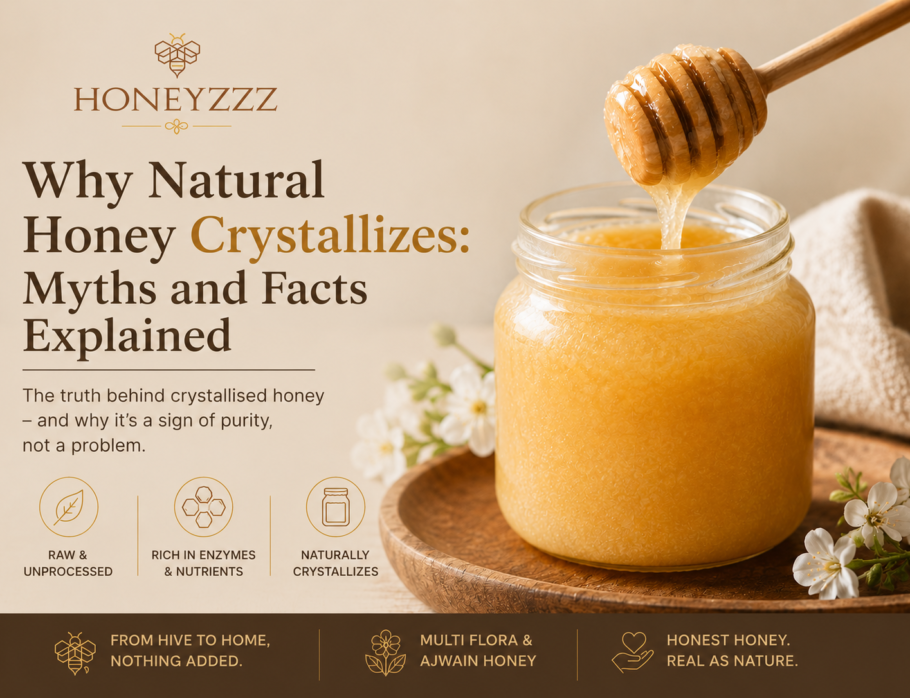
Crystallisation is not spoilage. It is not a sign of contamination, age, or poor quality. It is a completely natural, entirely reversible process that happens to real honey and only to real honey.
If anything, a jar of honey that never crystallises — no matter how long it sits at room temperature — is the one worth questioning.
So Why Does Honey Crystallise?
Honey is a supersaturated solution. It contains far more dissolved sugars than water can typically hold in a stable state. Over time, the glucose in honey — one of its two primary sugars — naturally separates from the water content and begins forming crystals.
The speed at which this happens depends on a few factors:
The ratio of glucose to fructose. Every type of honey has a different sugar composition depending on the flowers the bees foraged from. Honeys with a higher glucose-to-fructose ratio crystallise faster. This is why our Ajwain honey, with its distinct floral source, may behave differently from our Multi Flora blend.
Temperature. Honey crystallises most readily between 10°C and 15°C. This is why you might notice your honey thickening faster in cooler months or if stored in an air-conditioned room. Temperatures above 25°C slow the process; temperatures below freezing halt it almost entirely.
The presence of pollen and particles. In raw honey, naturally occurring pollen grains and microscopic particles act as nucleation points — tiny anchors around which glucose crystals begin to form. This is one of the reasons raw honey crystallises faster than processed honey, which has had all these particles removed.
The Fact: Crystallisation Is a Mark of Quality
Here is something worth sitting with: the fact that your honey crystallises is direct evidence of what it contains — and what has not been done to it.
Processed commercial honey resists crystallisation because it has been heated to high temperatures and ultra-filtered to remove pollen and particles. The result is a honey that stays liquid on shelves for months or years — but at the cost of its enzymes, antioxidants, and nutritional complexity.
Raw honey crystallises because it still has everything intact. The pollen, the enzymes, the natural sugar structure — all of it is exactly as the bees left it. Crystallisation is the proof of that.
Myth: Once Crystallised, Honey Is Ruined
Not at all. Crystallised honey is just as good as liquid honey — often better, because it spreads more easily on toast and releases its flavour more slowly.
If you prefer it in liquid form, softening crystallised honey is simple:
Place the jar in a bowl of warm water — not hot, not boiling — and leave it for 15 to 20 minutes. Stir gently. The crystals will dissolve and your honey will return to a smooth, pourable consistency without losing any of its natural properties.
What you should never do is microwave your honey or place it in boiling water. Temperatures above 40°C begin destroying the very enzymes and antioxidants that make raw honey worth choosing in the first place.
Myth: Only Low-Quality Honey Crystallises
The opposite is true. The finest, most nutrient-dense raw honeys in the world crystallise. Manuka honey crystallises. Sidr honey crystallises. Our Multi Flora and Ajwain honeys crystallise.
Meanwhile, the perfectly clear, perfectly liquid honey sitting in a plastic bear-shaped bottle at the bottom of a supermarket shelf — the one that has been there for two years without changing — has been processed so extensively that there is almost nothing left in it to crystallise.
What Honeyzzz Honey Does — and Why
Our honey is raw, cold-processed, and completely unheated. Which means it will crystallise. Not because something is wrong — but because everything is right.
Every jar we bottle carries the full natural composition of honey as the bees made it: enzymes, pollen, antioxidants, propolis traces, and natural sugars in their unaltered form. Crystallisation is simply what that honey does when it is left to be itself.
We consider it a feature, not a flaw. And once you understand what it means, we think you will too.
Try Honey That Is Honest About What It Is
At Honeyzzz, we do not process our honey to make it look better on a shelf. We harvest it by hand, filter it gently, and bottle it at natural temperature — so what reaches you is exactly what the bees made.
If your jar crystallises, that is us doing our job right.
Shop Honeyzzz Honey → Explore Our Story →
Honeyzzz is a family-owned raw honey brand based in Ahmedabad, Gujarat. We harvest pure, cold-processed Multi Flora and Ajwain honey from natural apiaries across India — from hive to home, nothing added.